Gamut
Gamut Labs · Action learning projects

Posse

A work in progress. Portable personal agents that people own and carry from job to job, built on reciprocity instead of extraction.

Tags
AITalent management
Work in progress · in development

Main questions

  1. Why do people hold back the tacit knowledge that makes them good at their jobs?
  2. What would it take for a person to own the AI helpers they build at work, and for an employer to welcome them?
  3. Can reciprocity, designed into the structure, speed up AI adoption more than mandates do?

The insight

After the initial adoption phase, AI transformation faces an uphill battle. How can we redesign company processes and workflows if the people who operate them see it as a threat to their professional livelihood? Identifying opportunities and improvements requires the tacit knowledge of experienced professionals.

One challenge to overcome is that most of us are not consciously competent. We do things well without knowing exactly how our why, so articulating it takes special expertise. Another issue is the standard practice that any knowledge created by people within a company belongs to the company. People sense the subtle risk of giving away their tacit expertise and hold back, because codifying their craft makes them easier to replace.

At least a portion of the innovation necessary to unlock full value of AI is happening in private, sometimes outside of the company systems. This creates a few problems including obvious security risks to the company. Also, as more people privately create their own skills, workflows and helper agents will they be able to bring them to work? Is this a durable new-world problem or a temporary problem of the adoption phase?

Kit and site

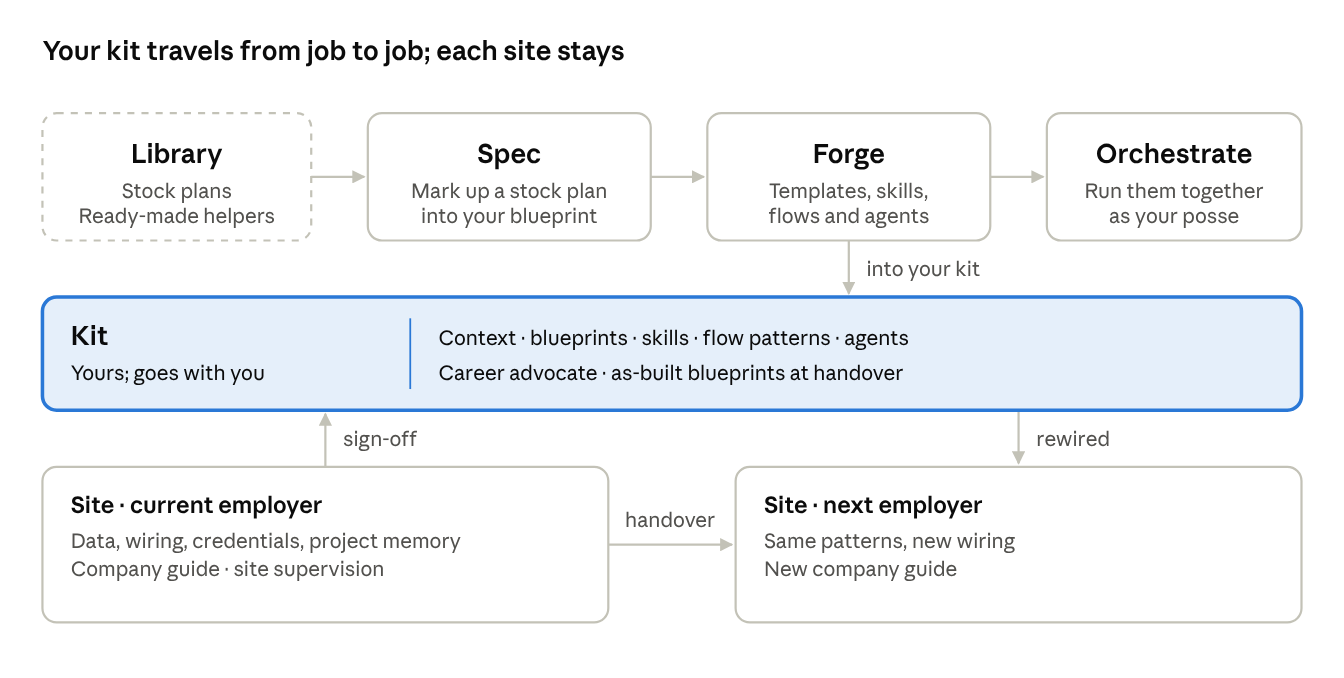
In homebuilding, a carpenter's tools belong to the tradespeople and the house belongs to the client. Posse applies that norm to AI. The kit is what the person owns and carries: their context, blueprints, skills and helpers. The site is the employer's data, systems and credentials. The keys to the house stay with the owner and once built, the workers have no access. Could this work for AI where functional/professional agents have durable, personalized traits that make a person a more valuable employee?

Diagram: Spec, Forge and Orchestrate feed a kit that moves from one employer's site to the next
Your kit travels from job to job; each site stays.

How it might work

Spec

Start from a stock plan for and profession or function and mark it up until it matches how an individual works. Recognizing your work against a stock plan is easier than describing it from a blank page. The result is a custom blueprint or template that contains no company-private information.

Forge

Build the parts the blueprint calls for: policies, skills, flows and agents and store them in a wallet or bench (maybe like a fantasy sports team?).

Orchestrate

Install and connect the appropriate parts of your kit to do a specific job, in the specific context at a specific company.

The trust model

Trust is an outcome of truth, accountability and support, so Posse provides the platform to deliver all three into a neutral platform with contractual and secure terms.

  • Truth: a kit declaration at hire records what you bring.
  • Accountability: anything learned on the job moves into your kit only with the employer's sign-off, and a handover certificate proves a clean exit.
  • Support: a career advocate that belongs to you, and whose conversations never reach your employer. A company advocate that belongs to the company and manages your private employment relationship terms.

Open questions

  • Where does a general skill end and a proprietary secret begin?
  • Will employers see portability as an employment strategy or a retention risk?
  • Who goes first: employees through employers, or independent professionals?

Writing

Sep 25, 2026

We Are All Becoming Agents

Flat organizations need people who behave with agency. Individual change precedes organizational change.

Sep 22, 2026

AI Is Oxygen

Companies that win with AI will be the ones that redesign their organization instead of optimizing it.